Quick matches
The standard turn clock is 180 seconds. Make a useful decision, verify the selected sector, then signal readiness.
 GAME OF WORLDS
LIVE RULESET
COMMANDER ORIENTATION // LIVE RULESET
Build an interstellar economy, turn uncertain sensor contacts into informed choices, and expand without feeding your fleet to the dark. Game of Worlds rewards deliberate risk—not blind clicking.
WAITING ROOM
Copy the room invitation link from the waiting room. Your friend can sign in, register, or use guest play, then choose a race to join that specific game. The host can add AI to open seats; Fill with AI & Start uses the selected difficulty and strategy. If the host leaves, another remaining commander becomes host automatically.
Chill opponents expand and build but do not launch raids, even with an aggressive strategy. Medium and Aggressive opponents attack while retaining a home guard.
BOOT SEQUENCE
You begin on a homeworld with a Scout, a Colony Ship, a Metal Extractor, a Crystal Refinery, and a Tier-1 Spaceport. This baseline guarantees income and local ship production. A nearby small world can be colonized without Terraforming research; further expansion still requires scouting and research.
START-OF-GAME ADVISORY
The event feed delivers a one-time advisory when your game screen connects. It explains the risk posture for unexplored space before your first order.
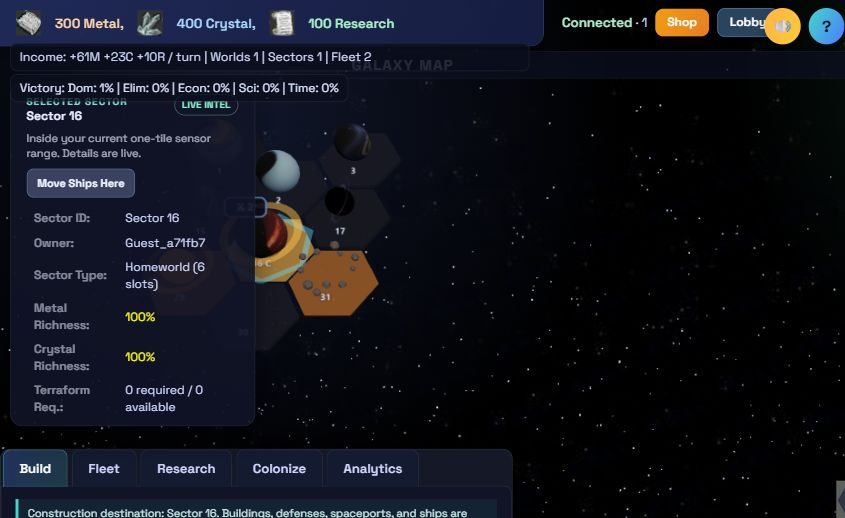
The standard turn clock is 180 seconds. Make a useful decision, verify the selected sector, then signal readiness.
Long turns suit asynchronous play. Standing orders matter more because you may be away when the server advances.
SENSOR DOCTRINE
Fog of war is graduated. Clicking a tile should tell you both what is known and how it became known.
No reliable intelligence. Choose a probe or fleet movement deliberately.
Your one-tile sensor ring can reveal terrain class, controller, and total presence—not full composition or resources.
A probe or visit created a fuller report. Dim tiles are old memory; fleets and ownership may have changed.
Your sector and nearby live contacts give the most dependable operational picture.
A probe costs 300 crystal. It can reveal a sector without committing ships, but hazards and counter-intelligence can destroy it. Successful reports become dated as turns pass.
LOCAL LOGISTICS
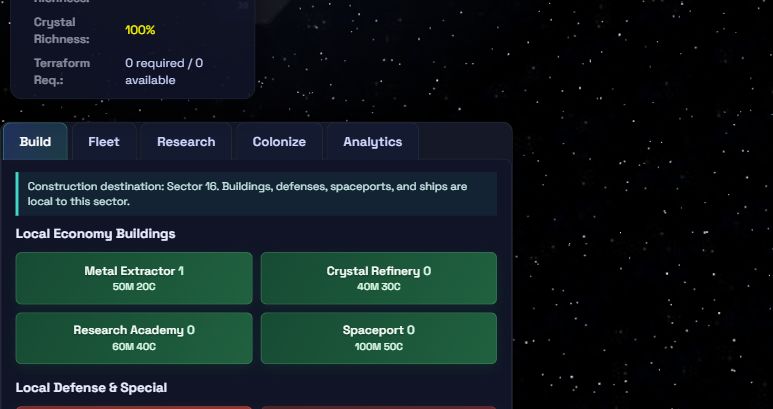
Resources and research are empire-wide. Buildings, defenses, Spaceports, Warp Gates, and newly built ships are sector-local. Select the destination world before opening Build.
The backbone of buildings and hulls. Rich worlds make natural industrial centers.
Funds probes, movement, some advanced ships, and flexibility.
Spent on empire technology. Academies improve its income locally.
NAVIGATION
Movement follows a direct plotted line from origin to destination. Every crossed sector matters: known obstacles appear in route preflight, while hazards in unmapped space remain unknown until encountered. Select the destination, choose Move Ships Here, select ships, review the summary, and confirm. Crystal cost scales with hulls and route length; research and racial traits can alter it.
Colonizable planets are sector types 6–9. You need a Colony Ship and enough terraform capability. Hazards resolve before control: a fleet that does not survive cannot establish a colony.
Build a Mining Hauler in Fleet at any Spaceport: its base cost is 300 metal and 3 production, with no Shipyards research needed. Send it to an unclaimed planet, even one beyond your Terraforming level. At turn end it fills a 100-resource hold with metal and crystal; planet richness determines the mix.
Return to any planet you own and end the turn to unload into your treasury. Fleet shows each hold and offers Plot return; review the ordinary fuel and hazard preview before confirming. Full holds stay full until delivered. Haulers are unarmed, enemy ships block cargo operations, and a destroyed ship loses its cargo. Black holes cannot be mined.
A paired network of owned Warp Gates bypasses normal-space route hazards between established hubs. Gates accelerate reinforcement, but a captured hub can reshape the front.
EMPIRE DOCTRINE
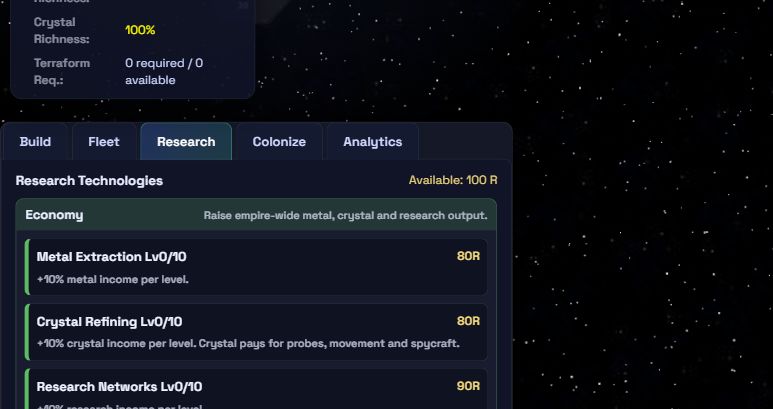
Research applies across your empire. Economy technology raises output; sensors and movement improve reach; Military Shipyards unlock heavier hull knowledge. You still need a local Spaceport to build a known hull.
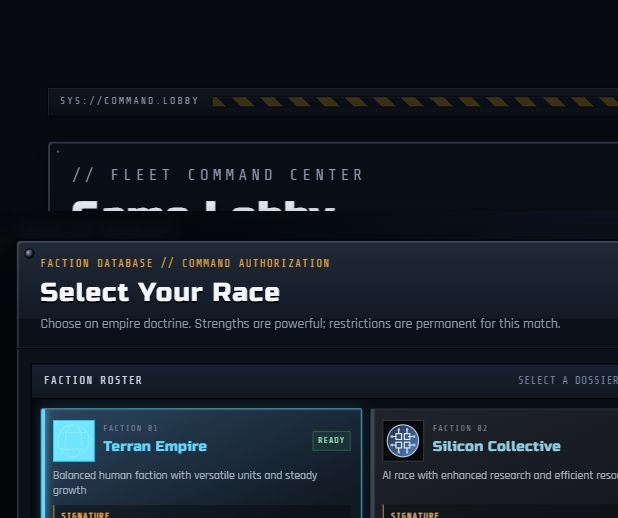
Every race changes strengths, costs, restrictions, or special behavior. Read both the advantage and restriction before confirming; restrictions are strategic identity, not flavor text.
THREAT FILE

Absolute danger. An entering fleet is annihilated; a probe is destroyed. Discovery does not mean safety.
Each entering ship risks destruction. Once you control the sector, it becomes safe for your transit.
Combat uses hull power, race effects, defenses, and researched advantages. Do not judge battles only by ship count. Preserve scouts for information, screen Colony Ships, and avoid committing everything to stale intelligence.
COMMAND PLAYBOOKS
LOW VARIANCE
Build crystal income, probe likely hazards, and expand behind reliable reports.
TEMPO
Claim a productive second world quickly, then add local extraction and a Spaceport.
COMPOUNDING
Stack income and turrets, research efficiency, then convert the advantage into fleets.
DISRUPTION
Maintain current intel, threaten weak production worlds, and withdraw before the response.
END STATES
The compact tracker stays out of the way; expand Victory Briefing in Analytics when you want exact objectives and progress.
QUICK REFERENCE